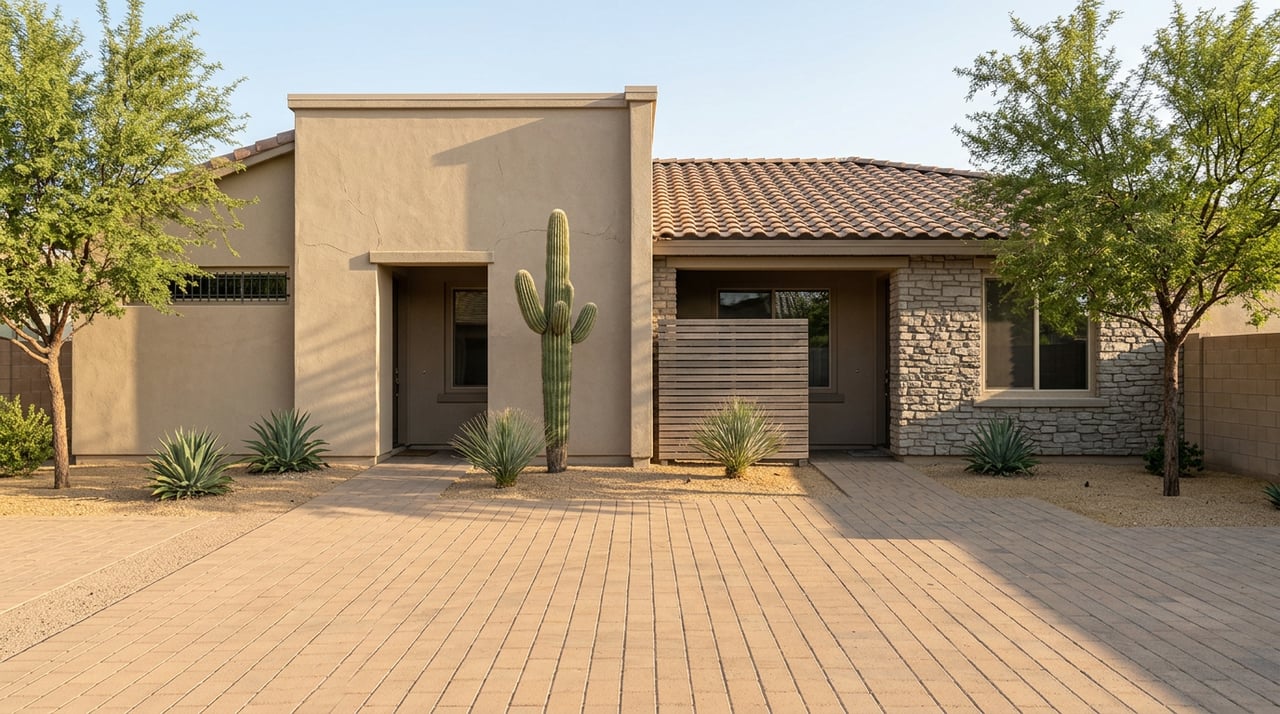
Desert Ridge listings may show one HOA fee even when a home is subject to both a master association and a sub-community association.
Desert Ridge is a 5,700-acre master-planned development with more than a dozen named sub-communities, and nearly every one of them sits inside two layers of governance at once: a master association that covers the whole plan, and a separate association that governs the specific pocket you're buying into. When comparing two homes here, consider the total HOA costs and the paperwork required by each association. A closing may require paperwork from both associations.
How Desert Ridge's Master and Sub-Community Associations Work
The master association is the Desert Ridge Community Association, managed by First Service Residential. It covers the things that touch the whole plan: shared multi-use paths, community-wide design standards, common landscape easements, the connective tissue that keeps Desert Ridge looking like one place instead of a dozen unrelated subdivisions stitched together near Loop 101 and State Route 51.
That master association does not run Aviano's private fitness center. It doesn't manage Toscana's gate and pool. It doesn't handle Fireside's clubhouse programming. Those are the job of a second, entirely separate association, one per sub-community, each with its own board, its own budget, and often its own management company. Aviano's is run by CCMC. Toscana's is handled by Associated Asset Management. Bella Monte's runs through Brown Community Management. Fireside, Talinn, Sky Crossing and the rest each have their own arrangement.
The master association and the sub-community associations have distinct roles. The gated, amenity-heavy sub-communities exist inside a master plan that also contains the JW Marriott Desert Ridge Resort and Wildfire Golf Club's two championship courses, the Palmer Signature and the Nick Faldo layouts. Those are privately operated and separate from any HOA, though Desert Ridge residents do get preferential access and pricing at Wildfire. The sub-HOA fee you're actually paying funds something narrower: your specific pocket's gate, pool, fitness room, or clubhouse, none of which the master association touches.
| Sub-community | Governed by master HOA | Layered with a separate sub-HOA | What the second association typically funds |
|---|---|---|---|
| Aviano | Yes | Yes, managed by CCMC | Gated entry, private fitness center, community pool |
| Fireside | Yes | Yes | Clubhouse, pools, tennis and pickleball courts |
| Toscana | Yes | Yes, managed by AAM | Gated entry, building exterior, condo common areas |
| Talinn | Yes | Yes | Gated entry, community amenities for a newer product line |
| Bella Monte | Yes | Yes, managed by Brown Community Management | Neighborhood-level amenities and standards |
What the Two-Association Structure Actually Costs You
The master HOA fee tends to be the smaller number, because it's only funding shared infrastructure across a plan that stretches for miles. The real variation lives in the sub-HOA, because that's where the actual amenities sit. A non-gated, no-frills pocket of Desert Ridge and a gated, pool-and-fitness-center community like Aviano can carry a master fee that's nearly identical and a sub-HOA fee that isn't close.
Condo product complicates this further. In Toscana, the second association isn't just funding a pool and a gate. It's funding building insurance, exterior maintenance, and shared structural elements the way any condo association does, which structurally pushes those dues higher than a single-family sub-HOA covering the same square footage of amenities. Two homes with the same list price in different pockets of Desert Ridge can have different total monthly costs once both HOA layers are included, so buyers should compare the fees for each association.
A listing may show the master HOA fee. Buyers should also review the sub-HOA fee for that specific pocket of Desert Ridge when estimating total monthly dues.
Resale Packages and Closing Timelines in Desert Ridge
In Desert Ridge, the HOA resale package can be an important part of the closing timeline because buyers may need documents from both the master association and the sub-community association.
Each association's management company needs time to compile the full disclosure package: CC&Rs, bylaws, current rules, the operating budget, the reserve study, recent board meeting minutes, insurance certificates, a delinquency report, and any pending or threatened litigation involving the association. That turnaround commonly runs seven to ten business days or more per association. If the initial request covers only the master association, the buyer's lender or title company may need to wait for the separate sub-HOA request and its documents, extending the escrow timeline.
A short sequence worth following, whether you're the one selling or the one under contract:
- Confirm which sub-community association governs the specific address, since gated and non-gated pockets can differ even within the same larger subdivision.
- Order the resale package from both the master association and the sub-association the same week you list, not after you accept an offer.
- Read the reserve study and delinquency report specifically for underfunded reserves or a high rate of past-due neighbors, both of which are the most common precursors to a special assessment.
- Confirm whether a transfer fee or capital improvement fee applies at closing, and how dues and any pending assessment prorate between buyer and seller.
- If you're the seller and you already know about a pending assessment or open litigation, disclose it before it surfaces in the package. A surprise that shows up in someone else's document late in escrow reads very differently than the same fact volunteered on day one.
The Financing Wrinkle in Condo-Heavy Pockets Like Toscana
Buyers financing a condo unit in Toscana with an FHA or VA loan face a check that single-family buyers elsewhere in Desert Ridge don't: project-level approval. The lender isn't just underwriting the buyer, it's underwriting the condo association itself, checking reserve funding, owner-occupancy ratios, and pending litigation at the project level before the loan can close. That review sits on top of the standard resale package review, and it's a second reason condo transactions in Desert Ridge's attached-product communities need more runway than a comparable single-family closing in Fireside or Sky Crossing.
What This Means When You're Comparing Two Listings Side by Side
As of a mid-August 2026 snapshot of active Desert Ridge inventory, listings were sitting at an average of roughly 91 days on market, even as homes that actually closed over the trailing twelve months moved in closer to 56 days. That gap between how long active listings have been sitting and how quickly recently sold homes actually moved is a real signal. It points to a market where pricing and readiness matter more right now than they did a year or two ago. Buyers and sellers comparing homes can also factor in combined HOA costs and the time needed to obtain resale documents.
If you're comparing two Desert Ridge homes priced within a few thousand dollars of each other, the master HOA fee alone won't tell you which one actually costs less to carry. The sub-HOA fee is where that answer lives, and it's worth pulling before you write an offer, not after.
Frequently Asked Questions
Does the HOA fee show up on my property tax bill? No. HOA dues, whether master or sub-association, are private association fees billed separately from your Maricopa County property tax statement. They're a contractual obligation tied to ownership, not a government assessment.
If I buy in a gated community like Aviano, do I get access to Wildfire Golf Club or the JW Marriott pool? No. Wildfire Golf Club and the JW Marriott Desert Ridge Resort are privately owned and operated, separate from any HOA. Desert Ridge residents do receive preferential access and pricing at Wildfire, but it isn't included in sub-HOA dues.
How early should I order the HOA resale package if I'm selling? Order from both the master association and the sub-association the same week you list. This gives both associations time to prepare their documents.
Does every sub-community have a second HOA layered on top of the master association? Most gated or amenity-rich pockets do. A few smaller, non-gated sections are governed by the master association alone. Confirm the specific structure for the address in question rather than assuming it matches a neighboring subdivision.
If you're weighing two Desert Ridge listings and want to understand the full HOA costs before you write an offer or set a list price, that's worth a conversation. John Rowan works Desert Ridge and the surrounding North Phoenix master plans regularly and can walk through what a specific sub-community's association structure actually means for your monthly number and your timeline. Let's Connect.
This article is general information, not legal, tax or financial advice. Consult a qualified professional about your situation.
